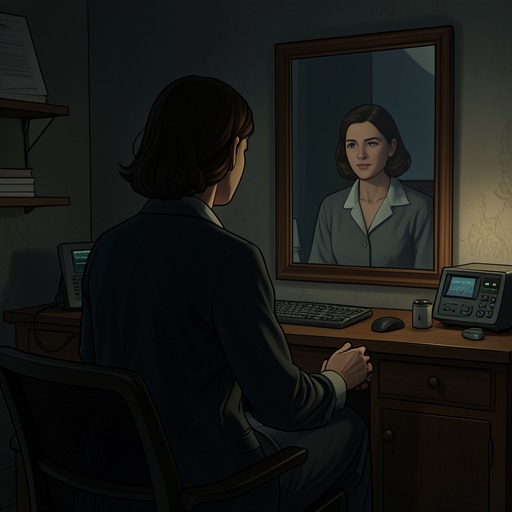
Je suis devenue ma propre illusionniste
Felix Austria“Je suis devenue ma propre illusionniste” names a moment of painful recognition: Stefania understands that she is no longer merely wandering through an illusion made by someone else, but actively producing one for herself. The phrase turns the language of spectacle inward, making self-deception at once an act of performance and a condition she can barely escape.
From Somnambulism to Recognition
The passage first casts Stefania as a sleepwalker moving across a roof, unaware of the danger until she reaches its edge. Nothing in the world has changed, she reflects; only the thinnest upper layer of air has been removed. The shift is in perception: what had seemed traversable is suddenly exposed as a ledge above a bottomless abyss.
That image gives the phrase its force. Stefania’s crisis is not described as a fall already completed, but as the discovery that she has been balancing over a precipice all along. The revelation strips away a protective surface without supplying a safer reality beneath it.
The Self as Illusionist and Audience
Stefania identifies herself as an illusionist who misleads herself while also playing to an audience willing to submit to hypnosis. The formulation makes self-deception more than passive confusion: she is both the producer of the misleading appearance and one of its deceived spectators. The audience image further suggests that the illusion persists through willing participation, even when the performance is directed inward.
The passage therefore divides the self between the person who stages an image and the person who accepts it as real. Its central tension is not simply between truth and falsehood, but between recognition and continued submission: Stefania can name the deception, yet the image of herself as a sleepwalker at the edge shows how little control that knowledge appears to offer.
Prayer After Illusion
The reflection moves from self-deception to prayer. Stefania no longer regards miraculous icons as necessary; prayer becomes the smoke of illusions that have burned away, rising and dispersing into the sky. The image does not promise that prayer will restore what has been lost. Instead, it links spiritual practice to the remains of consumed illusions, giving the passage an austere sense of release without a stated resolution.
The scene closes on bodily fragility and attachment. Stefania says she is almost extinguished, with only Adèle’s barely perceptible heartbeat remaining, when others rush into the room. The movement from the abyss to smoke and then to a faint heartbeat narrows the scale from vertiginous exposure to the most delicate sign of life. Adèle’s heartbeat remains the final point of connection as the outside world suddenly enters.